
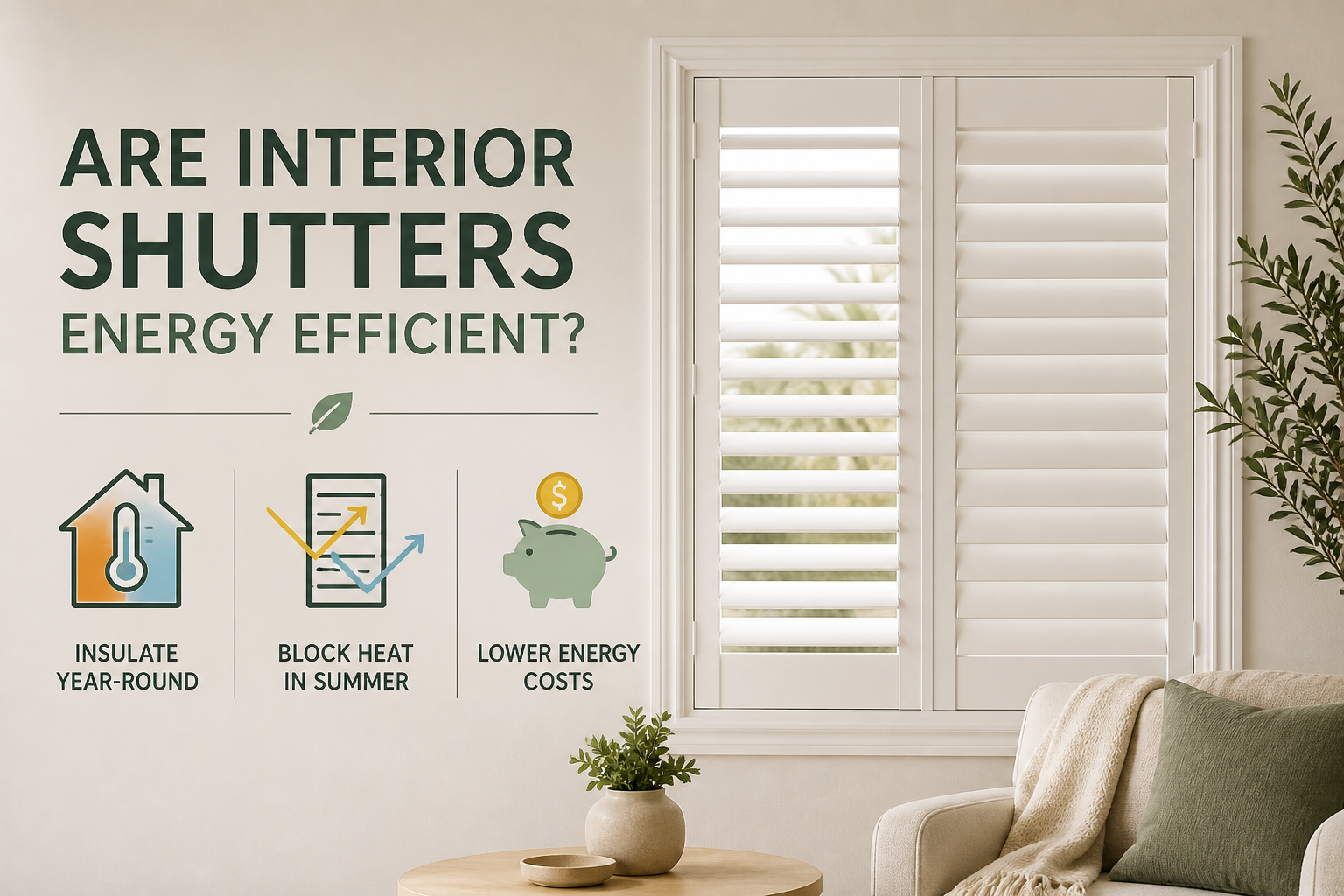

It’s a question we hear often at Shuttermart: do interior shutters actually make a difference on your energy bill, or is that just a selling point? The answer is yes — and the mechanism behind it is straightforward once you understand where most home energy loss actually happens. If you’ve been wondering whether are interior shutters energy efficient enough to justify the investment, this guide covers the how and the why — including a federal tax credit most San Diego homeowners don’t know they can claim.
After more than 70 years of installing custom shutters across San Diego County, our team at Shuttermart has seen the real-world impact of quality window treatments on home comfort and energy costs. Here’s what the data shows — and what we’ve seen firsthand in homes from Carlsbad to Chula Vista.
Windows Are Your Home’s Biggest Energy Weak Point
Contents
- 1 Windows Are Your Home’s Biggest Energy Weak Point
- 2 How Interior Shutters Block Heat and Lock In Comfort
- 3 San Diego’s Sunshine Problem — and How Shutters Solve It
- 4 Which Windows in Your Home Benefit Most from Energy-Efficient Shutters?
- 5 Can Interior Shutters Qualify for the Federal Energy Tax Credit?
- 6 How to Get the Most Energy Savings from Your Shutters
- 7 Frequently Asked Questions About Interior Shutters and Energy Efficiency
Modern San Diego homes are well insulated in most places. Attic insulation, wall batts, and double-paned glass have raised the baseline significantly over the past few decades. But even a well-sealed home with double-pane windows loses a disproportionate amount of energy through the glass. Up to 50% of a home’s heating and cooling energy escapes through the windows — more than through the roof, walls, and floors combined.
Glass conducts heat efficiently in both directions. In summer, solar energy passes through the pane and heats the room directly. In winter, the warmth your heating system generates gradually conducts outward through the cold glass surface. Insulation in the walls stops this kind of heat transfer. Glass, even double-pane glass, doesn’t.
Window treatments are the next layer of defense. And not all window treatments perform equally. Curtains and blinds create a loose barrier that traps some air near the glass but rarely seals well against the frame. Interior shutters — custom-fitted, rigid-panel shutters — create a significantly tighter and more effective thermal barrier.
How Interior Shutters Block Heat and Lock In Comfort
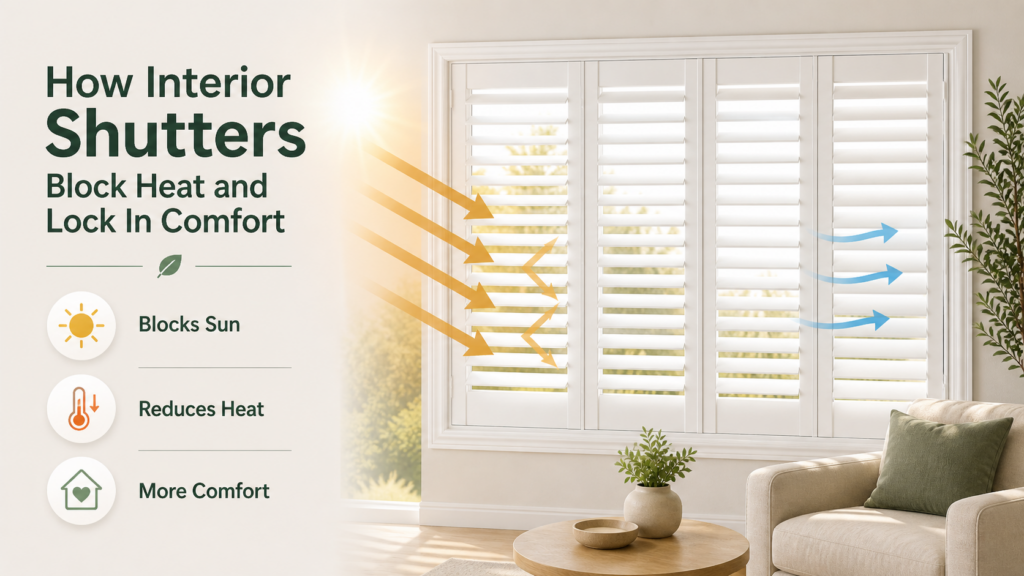
The energy efficiency of interior shutters comes down to two physical principles: conductive insulation and solar heat gain control.
Conductive insulation is the shutter’s ability to slow heat transfer between the warm interior of your home and the cool surface of the window glass. A custom-fitted shutter panel, when closed, traps a layer of still air between itself and the glass. Still air is a poor conductor of heat — it’s the same principle behind double-pane glass itself, and behind insulation batts in your walls. That trapped air layer acts as a buffer, slowing the rate at which warmth escapes outward in winter and reducing the rate at which outdoor heat conducts inward in summer.
Solar heat gain control is the shutter’s ability to block direct sunlight before it enters the room as heat. Sunlight passing through glass doesn’t just illuminate a room — it converts to infrared heat the moment it strikes a surface. Closing the louvers on a south- or west-facing window before peak sun hours prevents that solar energy from entering the room entirely, reducing the cooling load on your air conditioner before the heat ever accumulates.
Shuttermart’s Polyclad shutters with the ShutterSmart EnergyGuard Shutter Insulation System are specifically engineered to maximize both of these effects. The Thermocore louver design reduces heat loss through windows by as much as 66% — a performance level rigorous enough to exceed the U-factor and Solar Heat Gain Coefficient (SHGC) standards required by the Federal Energy Tax Credit program.
San Diego’s Sunshine Problem — and How Shutters Solve It
San Diego averages more than 260 sunny days per year. That’s an asset in almost every way — except when it comes to keeping your home cool. West- and south-facing rooms in homes throughout Mission Valley, El Cajon, Santee, and Rancho Bernardo absorb hours of direct afternoon sun during summer months, driving indoor temperatures up and pushing air conditioners into extended run cycles.
Coastal communities face a different version of the same problem. In neighborhoods like Point Loma, Ocean Beach, and Pacific Beach, homeowners often have large west-facing windows specifically positioned to capture ocean views and evening light. Those windows are beautiful — and in summer afternoons, they become solar collectors that can make living rooms genuinely uncomfortable without proper window treatment.
Interior shutters solve this in a way that no blind or curtain can match. Because the louvers are adjustable and rigid, you can admit indirect natural light from the upper portion of a window while the lower louvers remain angled to deflect direct sunlight away from the floor and furnishings. You keep the brightness without the heat gain. It’s a level of control that makes a practical difference in daily comfort and visible difference in monthly cooling bills.
In winter — and San Diego does have winters, especially inland — the same shutters that block summer heat double as an insulating layer that slows overnight heat loss. Homes in Escondido, Ramona, and other inland communities where winter nights drop into the 40s benefit meaningfully from this effect across large windows and sliding glass doors.
Which Windows in Your Home Benefit Most from Energy-Efficient Shutters?
Not every window in your home contributes equally to energy loss. Prioritizing the right windows gives you the best return on your shutter investment:
- South- and west-facing windows: These receive the most direct sun during the hottest part of the day and are responsible for the majority of summer solar heat gain. Shutters here deliver the largest impact on cooling costs.
- Large living room and family room windows: High-volume rooms with oversized windows have more glass surface area conducting heat — and more air volume to heat or cool. Shutters on these windows have an outsized effect on whole-home comfort.
- Bedroom windows: Overnight heat loss through bedroom windows affects sleep comfort in winter and makes rooms harder to cool in summer. Closing shutters at night in any season creates a noticeably more stable room temperature.
- Sliding glass doors: These are some of the least insulated surfaces in most San Diego homes — large glass panels with minimal frame, often oriented toward the backyard and afternoon sun. Door shutters or full-coverage panel shutters on sliding doors can produce significant energy savings.
- East-facing windows: These see intense early morning sun that heats rooms before peak cooling hours. Managing morning solar gain on east-facing windows reduces how hard your air conditioner has to work through the rest of the day.
Can Interior Shutters Qualify for the Federal Energy Tax Credit?
This is the part most homeowners are surprised to learn. Yes — qualifying interior shutters are eligible for a federal energy tax credit equal to 30% of the purchase cost, up to a maximum credit of $1,200. The standards to qualify are rigorous: a product must meet specific U-factor and SHGC thresholds set by the federal program, and most generic window treatments don’t come close.
Shuttermart’s Polyclad shutters with the ShutterSmart EnergyGuard Insulation System passed these tests and exceed the required thresholds. That means when you purchase a qualifying Polyclad installation through Shuttermart, you may be eligible to claim a tax credit that offsets a meaningful portion of the total cost — effectively reducing your investment from the moment you file your return.
To claim the credit, you’ll need documentation confirming that the product meets the federal requirements. Our team provides this as part of the purchase process. If you’re planning a shutter installation this year, ask your Shuttermart designer to confirm which products qualify and what paperwork you’ll need to retain for your tax filing.
How to Get the Most Energy Savings from Your Shutters
Getting the energy performance you’re paying for comes down to a few practical factors that are easy to get right with proper installation and use:
- Custom fit is non-negotiable: A shutter that leaves gaps at the frame edges won’t create the air seal needed for full insulation performance. Shuttermart’s custom-measured shutters are built to your exact window dimensions — no gaps, no light leaks, no lost insulation value.
- Close them at the right times: For summer cooling, close south- and west-facing shutters before noon to intercept solar heat gain before it accumulates. For winter warmth, close all shutters at sunset to retain heat through the night.
- Use louver angle strategically: Fully closed louvers provide maximum insulation. Angled louvers still reduce solar gain while admitting diffuse daylight. Learning to use louver angle throughout the day is the difference between a shutter that functions as window decoration and one that actively manages your home’s thermal environment.
- Prioritize high-sun exposures first: If you’re phasing a whole-home installation, start with south- and west-facing rooms. The energy return on these windows is highest, and comfort improvements will be immediately noticeable.
- Pair with well-sealed frames: Even the best shutter performs better when the window frame it sits against is properly sealed. If your frames have air gaps or deteriorated weatherstripping, address those before installation for maximum performance.
Ready to see what energy-efficient shutters could do for your San Diego home? Our free in-home consultations include a room-by-room assessment of your windows, a recommendation for which products will deliver the best thermal performance, and full documentation for any qualifying federal tax credit. Call 1-619-276-6722 or reserve your appointment online — our designers serve all of San Diego County.
Frequently Asked Questions About Interior Shutters and Energy Efficiency
How much energy can interior shutters save?
Properly fitted interior shutters can reduce heat loss through windows by as much as 66%. Since windows account for up to 50% of a home’s heating and cooling energy loss, quality shutters can deliver meaningful reductions in monthly utility bills — particularly on south- and west-facing windows with high sun exposure.
Are interior shutters better than blinds or curtains for insulation?
Yes. Interior shutters outperform both blinds and curtains for insulation. Their rigid construction and custom fit create a tighter seal against the window frame, minimizing air infiltration and heat transfer. Louver adjustability also lets you fine-tune light and heat control in a way that fabric treatments simply can’t match.
Do interior shutters qualify for a federal energy tax credit?
Qualifying shutters can earn a federal energy tax credit equal to 30% of the purchase cost, up to a maximum of $1,200. Shuttermart’s Polyclad shutters with the ShutterSmart EnergyGuard Insulation System exceed the U-factor and SHGC requirements set by the federal program. Ask your Shuttermart designer for documentation to support your tax credit claim.
Which windows benefit most from energy-efficient shutters in San Diego?
South- and west-facing windows see the greatest energy savings because they receive the most direct sun during the hottest parts of the day. Large living room windows, bedroom windows, and sliding glass doors are also high-priority targets. In coastal San Diego neighborhoods, any window exposed to marine-layer temperature swings benefits from the added insulation layer shutters provide.
Do shutters help keep a home cool in summer as well as warm in winter?
Yes. Interior shutters work in both directions. In summer, closing the louvers on sun-exposed windows blocks solar heat gain before it enters the room, reducing the load on your air conditioner. In winter, closed shutters trap a layer of still air between the panel and the glass, slowing the rate at which indoor warmth escapes through the window.
Comments are closed.